Introduction
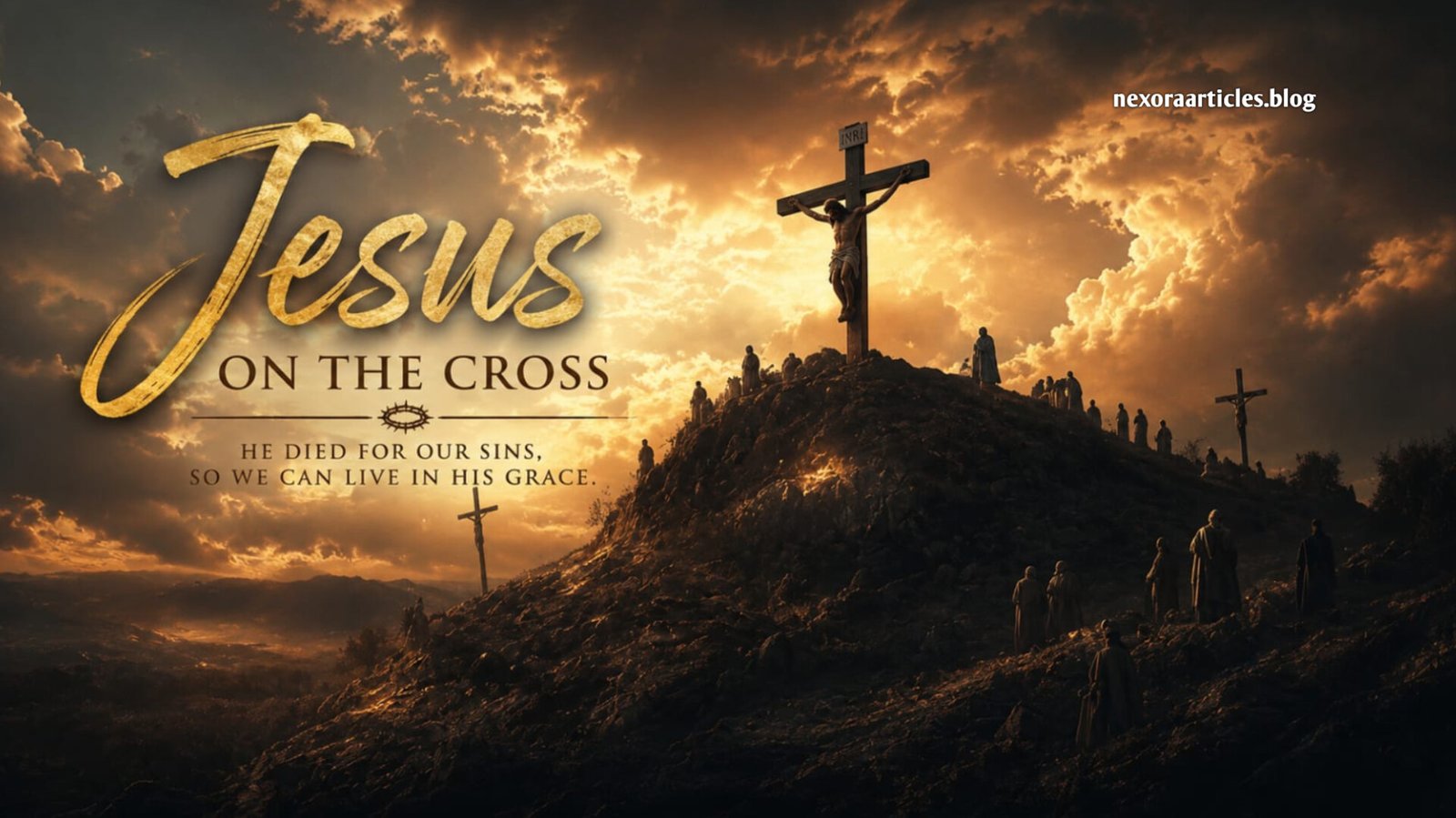
The image of Jesus on the cross is one of the most recognizable symbols in Christianity. For Christians, the crucifixion is not simply the story of a painful death. It is closely connected to ideas of sacrifice, forgiveness, redemption, love, and the hope of resurrection.
The New Testament Gospels—Matthew, Mark, Luke, and John—describe Jesus being arrested, condemned, crucified, and buried. Although each Gospel emphasizes different details, all four place the crucifixion at the center of the final part of Jesus’ earthly ministry.
Understanding Jesus on the cross requires looking at both the historical event described in the Gospels and its religious meaning. The cross represents suffering and death, but within Christian belief, it also points toward resurrection and the promise of new life.
What Happened to Jesus on the Cross?
According to the New Testament, Jesus was arrested in Jerusalem after the Last Supper and brought before authorities. He was questioned, condemned, mocked, beaten, and eventually led to the place of execution known as Golgotha, or Calvary.
Crucifixion was a Roman method of execution designed to be painful, public, and humiliating. Jesus was nailed to a cross and placed between two other condemned men. A sign identifying Him as “King of the Jews” was placed above Him, although the wording differs slightly among the Gospel accounts.
The Gospel narratives describe several people who witnessed the crucifixion, including some of Jesus’ followers and women who had been associated with His ministry. The accounts also describe darkness covering the land during the final hours.
Jesus eventually died on the cross. His body was then taken down and placed in a tomb. According to Christian belief and the Gospel accounts, His death was followed by His resurrection on the third day.
Why Was Jesus Crucified?
There are two closely connected ways to answer this question: the historical explanation and the Christian theological explanation.
Historically, Jesus was executed by Roman crucifixion. The Gospel accounts connect His death with accusations surrounding His identity and claims about kingship, while also describing opposition from religious leaders.
From the Christian perspective, however, the crucifixion has a deeper meaning. Christians believe that Jesus willingly gave His life for humanity, taking upon Himself the consequences of sin and opening the way to reconciliation with God.
These two perspectives are not necessarily contradictory. The Roman authorities carried out the execution, while Christian theology interprets the event as part of God’s plan of salvation.
The Meaning of Jesus on the Cross
The cross has several important meanings within Christianity. Different Christian traditions may explain them using different theological language, but several themes appear repeatedly.
Sacrifice
One of the central Christian interpretations is that Jesus’ death was a sacrifice for sin. The New Testament repeatedly connects Jesus’ death with forgiveness and reconciliation.
This idea can be difficult to understand if viewed only as a historical execution. Within Christian theology, however, Jesus’ death is understood as an intentional act of self-giving rather than merely the tragic end of His life.
Forgiveness
The cross is also associated with forgiveness. Jesus’ words and actions during His final hours are presented in the Gospels as examples of mercy, even toward those involved in His execution.
For Christians, this communicates that forgiveness is not limited to people who deserve it. It is connected to God’s grace and compassion.
God’s Love
The crucifixion is often understood as a powerful expression of divine love. Christian teaching holds that God did not remain distant from human suffering but acted through Jesus to bring reconciliation.
John 3:16 is frequently associated with this idea, describing God’s love for the world and connecting that love with the giving of His Son.
Victory Through Suffering
At first glance, the cross looks like defeat. Jesus is rejected, tortured, and killed. Christianity, however, interprets the crucifixion together with the resurrection.
The message is therefore not simply that Jesus suffered and died. It is that death did not have the final word. The cross and empty tomb belong together in the central Christian story.
The Seven Sayings of Jesus on the Cross
Christian tradition often refers to several statements attributed to Jesus during the crucifixion as the “Seven Last Words” or “Seven Sayings from the Cross.”
These statements are collected from the four Gospel accounts rather than appearing together in one Gospel.
Father, forgive them”
In Luke’s account, Jesus asks His Father to forgive those responsible for His suffering. The saying is closely associated with Christian ideas of mercy and forgiveness.
Today you will be with me in paradise”
Luke also records Jesus speaking to one of the criminals crucified beside Him. The statement offers hope to a condemned man who turns toward Jesus.
Woman, here is your son”
In John’s Gospel, Jesus speaks to His mother and the disciple described as beloved. The scene is often interpreted as showing Jesus’ concern for His family and followers even during His suffering.
My God, my God, why have you forsaken me?”
Matthew and Mark record Jesus crying out these words. They echo Psalm 22, an important biblical psalm that begins with a cry of abandonment and continues toward trust in God.
This statement is particularly significant because it expresses the depth of Jesus’ suffering while also connecting the crucifixion narrative with Israel’s Scriptures.
I thirst”
John records Jesus saying that He was thirsty. The statement emphasizes the physical reality of His suffering and death.
It is finished”
According to John’s Gospel, Jesus says, “It is finished” before dying. Christians have often understood this as a declaration that His earthly mission had reached its completion.
Father, into your hands I commend my spirit”
Luke’s Gospel presents these as Jesus’ final words. They echo Psalm 31 and express trust in God at the moment of death.
Jesus on the Cross Between Two Criminals
One of the memorable details in the crucifixion accounts is that Jesus was executed alongside two other men.
Luke provides the most detailed account of their interaction. One criminal mocks Jesus, while the other acknowledges his own guilt and asks Jesus to remember him.
Jesus responds with a promise of paradise.
This scene has become an important Christian example of grace. The man has little opportunity to prove himself through future actions, yet he turns toward Jesus in his final moments. The passage is therefore often used when discussing repentance, mercy, and salvation.
What Did the Cross Look Like?
The New Testament does not provide a detailed technical description of the physical construction of Jesus’ cross. As a result, artistic representations vary considerably.
Many paintings and films show Jesus on a tall cross with a long vertical beam and shorter horizontal beam. Christian art has also developed many other forms over the centuries.
The exact visual appearance is less important to Christian theology than what the crucifixion represents. The cross has become a symbol because of the event associated with it, not because the New Testament gives believers a required artistic design.
Why Is Jesus Often Shown Wearing a Crown of Thorns?
Before the crucifixion, Roman soldiers mocked Jesus as a king. According to the Gospels, they placed a crown made of thorns on His head and dressed Him in a way intended to ridicule His claim to kingship.
The crown of thorns therefore carries a strong symbolic meaning. It represents both suffering and the irony of Jesus being mocked as king.
For Christians, the image can also express a larger theme found throughout the Gospel story: Jesus’ kingship is presented in a radically different way from ordinary political power. His authority is associated with humility, service, sacrifice, and love.
Jesus on the Cross and the Resurrection
The crucifixion cannot be separated from the resurrection in Christian belief.
The Gospels state that Jesus died, was buried, and that His tomb was later found empty. His followers then claimed to have encountered Him alive. The resurrection became the foundation of the early Christian proclamation.
This is why the cross alone does not summarize the Christian message. The cross represents Jesus’ death, while the resurrection represents victory over death and the beginning of a new hope.
Paul’s writings also place the death and resurrection of Jesus at the heart of Christian faith. In 1 Corinthians 15, the resurrection is treated as essential rather than as a secondary detail.
Why Do Christians Wear Crosses?
The cross became one of Christianity’s most recognizable symbols. Christians may wear a cross as jewelry, place one in churches, display it in homes, or use it during worship.
For many believers, wearing a cross is a public reminder of Jesus’ sacrifice and teachings. It can also represent personal faith, hope, forgiveness, and commitment to following Christ.
The meaning can differ from person to person. Some view it primarily as a symbol of salvation, while others emphasize Jesus’ suffering, love, or victory over death.
Crucifix vs. Empty Cross
There is an important difference between a crucifix and a simple cross.
A crucifix normally shows Jesus’ body on the cross. It is especially common in Roman Catholic, Anglican, and some Lutheran traditions.
An empty cross does not show Jesus’ body. Many Protestant traditions prefer this form because it emphasizes the resurrection and the belief that Jesus is no longer dead.
Neither image tells the whole Christian story by itself. The crucifix highlights the sacrifice and suffering of Jesus, while the empty cross can emphasize resurrection and victory.
What Can Jesus on the Cross Teach Modern Readers?
Even apart from theological questions, the crucifixion story raises themes that remain meaningful to millions of people.
Forgiveness in difficult circumstances
Jesus’ response to suffering is frequently presented as an example of forgiveness. For Christians, this does not mean ignoring injustice. Rather, it points toward refusing to allow hatred to become the final response to wrongdoing.
Compassion for others
Even while suffering, Jesus is portrayed as responding to other people. His interaction with the criminal beside Him and His concern for His mother are examples of this theme.
Hope after suffering
The Christian story does not end at the cross. The resurrection gives the crucifixion a message of hope and renewal.
For people facing grief, failure, or hardship, this connection between suffering and hope is one reason the cross remains such a powerful Christian symbol.
What the Bible Says About Jesus’ Death
The crucifixion is described in all four canonical Gospels:
Matthew 27 describes Jesus’ condemnation, crucifixion, death, and burial.
Mark 15 provides another account of the trial, crucifixion, and death.
Luke 23 includes the interaction between Jesus and the criminals and records Jesus’ final prayer.
John 19 includes details such as Jesus’ conversation with His mother and the statement “It is finished.”
Reading the four accounts together is useful because each Gospel has its own emphasis. Rather than assuming every detail is presented in exactly the same way, readers can examine what each writer chooses to highlight.
Is Jesus on the Cross a Historical Event?
The crucifixion of Jesus is widely treated by historians as a historical event, although theological claims about its meaning belong to the realm of religious belief.
The Roman practice of crucifixion is well established historically, and the New Testament consistently presents Jesus as having been crucified under Roman authority.
The question of what Jesus’ death accomplished spiritually is different. Christians affirm that His death was part of God’s plan for salvation, while people outside Christianity may interpret the event differently.
Keeping those categories separate helps readers understand both the historical discussion and the Christian theological interpretation.
Conclusion
Jesus on the cross represents one of the central events of the Christian faith. The Gospel accounts describe a real execution by crucifixion, but Christianity understands that death as far more than the end of Jesus’ earthly life.
For Christians, the cross represents sacrifice, forgiveness, mercy, love, and reconciliation with God. Its meaning becomes even clearer when viewed alongside the resurrection, which Christians believe transformed an apparent defeat into a message of hope and new life.
Whether someone approaches the story from a religious, historical, or cultural perspective, the image of Jesus on the cross remains deeply influential. Its enduring significance comes not only from the suffering depicted there, but from the larger message Christians associate with it: that forgiveness can overcome hatred, love can exist in the face of suffering, and death does not have to be the final word.
Visit also : nexoraarticles.blog
Why was Jesus put on the cross?
According to the Gospel accounts, Jesus was sentenced to crucifixion under Roman authority after being accused in connection with His identity and claims about kingship. Christians additionally believe His death served a saving purpose for humanity.
What did Jesus say while on the cross?
The Gospels record several statements, including prayers for forgiveness, a promise to the repentant criminal, “My God, my God, why have you forsaken me?”, “I thirst,” “It is finished,” and a final prayer committing His spirit to God.
Where was Jesus crucified?
The Gospels identify the place as Golgotha, also called Calvary. It was located outside Jerusalem.
Who was Jesus crucified with?
According to the Gospel accounts, Jesus was crucified between two criminals. Luke gives the fullest account of their conversations with Jesus.
What does the cross symbolize in Christianity?
The cross commonly symbolizes Jesus’ sacrifice, forgiveness, reconciliation with God, love, and salvation. When considered alongside the resurrection, it also points toward hope and victory over death.
What is the difference between a cross and a crucifix?
A cross is generally represented without Jesus’ body, while a crucifix includes an image of Jesus on the cross. Different Christian traditions use one or both forms.
Did Jesus rise after being crucified?
According to the New Testament, Jesus was resurrected on the third day after His crucifixion. The resurrection is a foundational belief of Christianity.